Always Change a Running System
re:cap's solar park Schalkwijk joined Next Kraftwerke's virtual power plant in 2024. Since then, a lot has been done on the park so that it can be deployed on all markets. The park now also delivers aFRR, helping to keep the power grid in balance.
For decades, keeping the European power grid in balance was a job for rotating synchronous generators: heavy rotating masses in coal, gas and nuclear plants that damped sudden load changes (frequency gradients) in the grid by their physical inertia. Near the Dutch village of Schalkwijk, a very different kind of power plant is now qualified to balance the power grid - a solar farm the size of 23 football fields spread along roughly a kilometer of former grassland by the Amsterdam-Rhine Canal, with no moving parts at all.
In 2024, the Swiss renewable energy investment advisor and asset manager re:cap global investors ag appointed Next Kraftwerke to optimize the electricity production of the 17,61 MWp solar farm. Since then, various technical upgrades have been implemented to enable Next Kraftwerke’s full spectrum of cross-market optimization strategies. While already active in wholesale power markets and congestion management, the plant's first delivery of automatic Frequency Restoration Reserve (aFRR) in August 2026 represents a landmark achievement, underscoring its operational excellence and ability to deliver critical grid-balancing services in real-time.

So how does balancing work with the Schalkwijk solar park?
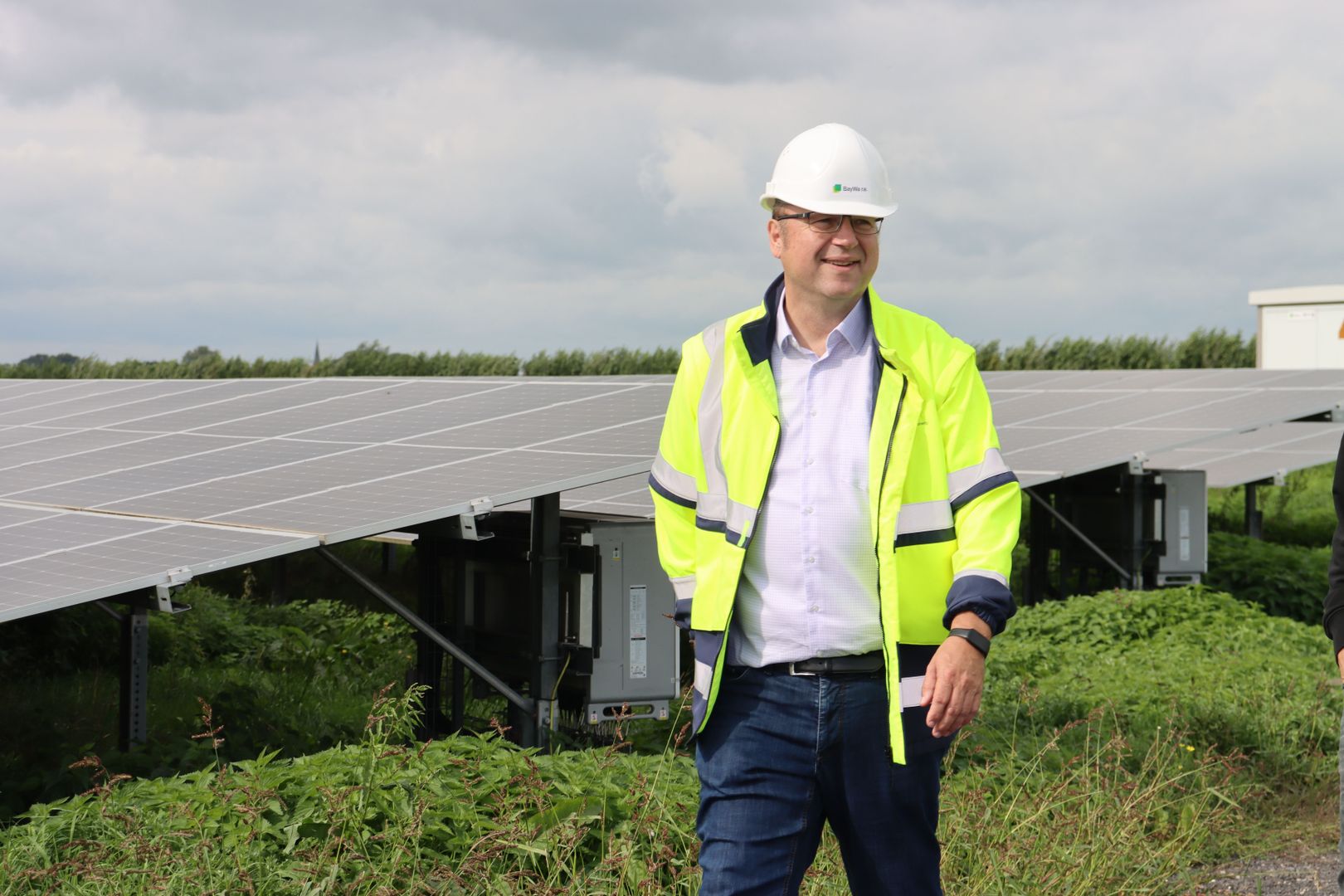
Kolja-Enrico Welchering, Technical Project Manager at BayWa, explains that a dedicated control system at the solar park receives real-time signals via the "Next Box". It distributes these across the park's nine transformer stations and 64 inverters. This allows the installation to raise or lower its output precisely when the grid requires it.
"An inverter can adjust its output within milliseconds," Welchering explains. "But working in near real time brings its own technical challenges, especially regarding data resolution and transmission delays. Still, it's very exciting that solar plants are now able to provide ancillary services to actively stabilize the grid."
Curtailments, in Welchering's telling, can even protect the hardware: "Curtailments extend the plant's life-time. When the sun is blasting down in summer, curtailments significantly lower internal temperatures by approximately 20°C reducing the electric and thermal stress to the inverter electronics. It’s good to come off the grid for a while – a bit of a “siesta”, mostly for the sake of temperature.
According to Welchering, the solar park is now well positioned for the future. "We have made significant progress in strengthening the facility’s technical resilience to match the solar farm electricity generation with the consumers demand side," he says. "The close relationship with our client re:cap and the excellent cooperation with Next Kraftwerke have been key to that success."

For re:cap, being able to deliver aFRR is a key building block of its pan-European cross-market optimization strategy.
“With growing price volatility and more frequent negative electricity prices, flexibility is becoming increasingly valuable across the 1,5 GW renewable energy portfolio managed by re:cap”, says Dr. Adrian Renfer, Head of Energy Markets Optimization at re:cap.
“Our objective is to optimize revenues across all electricity markets. Supported by BayWa’s technical expertise and Next Kraftwerke’s market integration capabilities, the successful participation in ancillary services demonstrates how innovative optimization strategies can create new revenue streams for our investors beyond the traditional power sales”.
Whatever direction the electricity markets take, the Schalkwijk plant has already shown its capability to do its part.
Key figures:
| Installed capacity: | 17,61 MWp |
| Provides grid flexibility: | aFRR, CSC |
| Link to partner website: | re:cap global investors |
| More about Next Products: | Products |